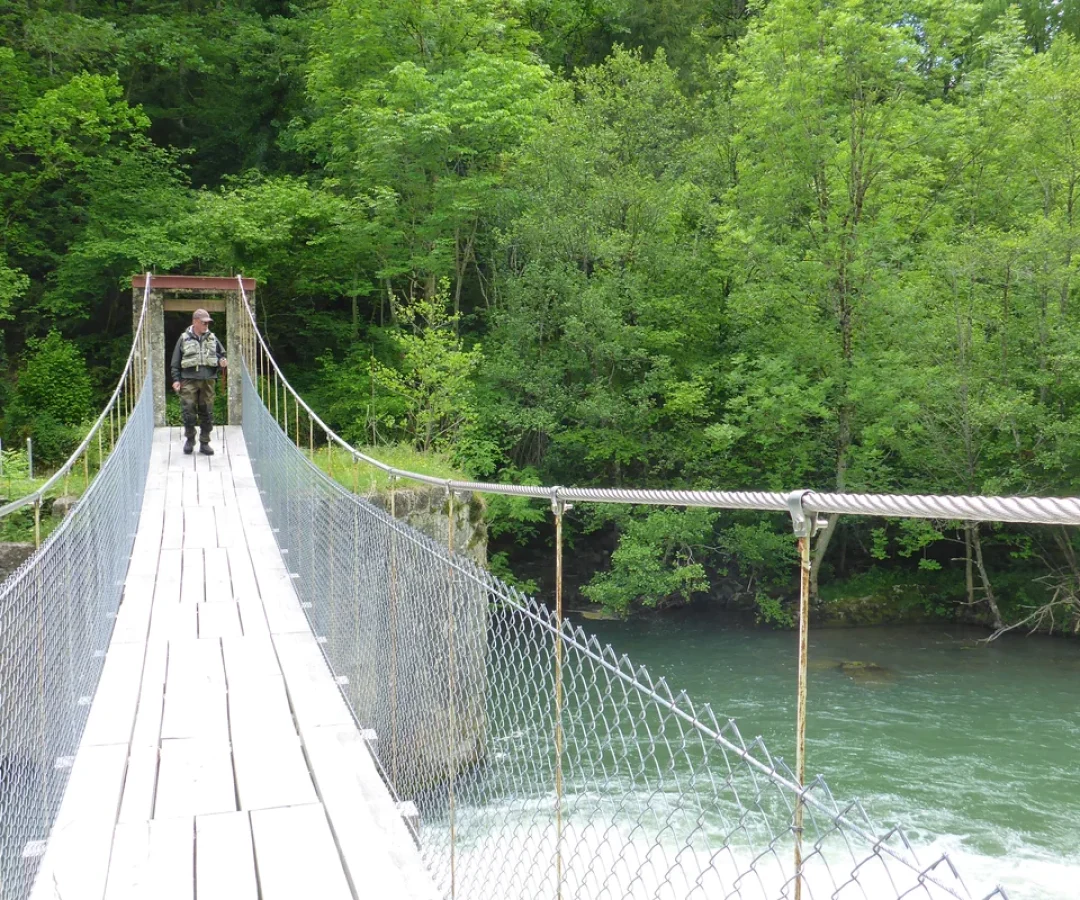
FLY FISHING IN FRANCE
From the snow-fed freestone rivers of the Alps and Pyrenees to the gin-clear spring creeks of the Jura, France has some of the most varied and rewarding fly fishing in Europe. This is the country that perfected euro nymphing, has won more world fly fishing championship medals than any other nation, and still holds thousands of kilometres of wild trout water that most travelling anglers don’t know about. We work with experienced, certified local guides who know these rivers inside out, so you can fish smarter from day one.
About the Destination
FRANCE — WHERE MODERN FLY FISHING WAS BORN
France is one of the best fly fishing destinations on the planet, and most English-speaking anglers have no idea. They default to New Zealand, Montana, or Patagonia without realising the French invented modern competition nymphing, hold more world championship medals than any other nation, and have over 280,000 kilometres of rivers running through landscapes that range from Mediterranean gorges to glacial alpine valleys.
What sets France apart is the sheer variety. You can fish wild brown trout in a Pyrenean mountain stream at dawn, drive two hours, and cast to grayling on a broad limestone river by afternoon. The Hautes-Alpes department alone contains 1,700 kilometres of first-category trout water. The Jura produces zebra trout in spring creeks so clear you can count the spots on a fish at twenty metres. And the Atlantic rivers of the south-west still run Atlantic salmon — one of the last wild populations in Western Europe.
We partner with state-certified French guides who have spent decades on these waters. Whether you want a half-day introduction to Tenkara in the Basque Country, a week-long road trip through the alpine valleys above Nice, or a self-guided adventure with local knowledge to point you in the right direction, we can put the right trip together. France rewards anglers who do their homework — and we’ve done ours.
FEATURED FLY FISHING TRIPS
We work with carefully selected, certified local guides across France’s best fly fishing regions. Each guide brings deep knowledge of their home waters — species behaviour, hatch timing, access points, local regulations. Here are two of our most popular guided experiences.
BASQUE COUNTRY WILD BROWN TROUT
Fish the Basque Nives — over 400 kilometres of riverbank winding through the green valleys of the French Basque Country — with Yvon Zill, a certified Tenkara specialist with more than a decade guiding these waters from his base in Arnéguy. Yvon offers both western fly fishing and traditional Japanese Tenkara techniques across pristine mountain streams holding wild brown trout and barbel. For something special, join his Hemingway Rio Irati expedition: a full day crossing into Navarre, Spain to fish the same river that captivated Ernest Hemingway. Available May and June only. Half-day and full-day options for solo anglers or pairs.
Duration: Half-Day & Full-Day Options Price: Enquire for Rates Species: Wild Brown Trout, Barbel
FRENCH RIVIERA & PROVENCE-ALPES — WILD FARIO
Guillaume Durand is a state-certified guide based near Nice who offers something you won’t find many places: wild trout fishing within an hour of the Mediterranean coast. With diplomas from both CNFMP and FFPML, Guillaume guides across more than a dozen rivers in the Provence-Alpes region — from the Verdon Gorges to the headwaters of the Vésubie, Estéron, and Gordolasque. The area gets 300 days of sunshine per year and transitions fast from Mediterranean scrub to full alpine terrain. Guillaume teaches fly fishing, TLT, Tenkara, and casting technique, making his trips a good fit for seasoned anglers and beginners alike. Half-day, full-day, and three-hour initiation sessions available.
Duration: Half-Day & Full-Day Options Price: Enquire for Rates Species: Wild Brown Trout (Fario), Southern Barbel
Why Fly Fish France
WHAT MAKES FLY FISHING IN FRANCE DIFFERENT
UNMATCHED RIVER DIVERSITY
No other European country packs this many different fly fishing environments into such manageable distances. Alpine freestone, Jurassic spring creek, Pyrenean mountain torrent, Atlantic salmon river, Mediterranean gorge — France has them all, connected by good roads and rail. You can fish a different type of water every day of a week-long trip without ever feeling rushed.
WILD, SELF-SUSTAINING TROUT
France’s first-category rivers hold wild, naturally reproducing brown trout — both the Atlantic strain and the striking Mediterranean zebra trout. Stocking on premium waters has been reduced or dropped entirely in favour of catch-and-release regulations and habitat work. The fish are wild, wary, and hard-earned. That’s the point.
SKILLED GUIDES, GOOD VALUE
French fly fishing guides hold state-certified diplomas and are among the most technically capable in the world — this is the country that dominates international competition fly fishing. Yet guide rates, accommodation, and travel costs sit well below comparable destinations in Scandinavia, Iceland, or the Anglophone world. Factor in the food and wine and it’s hard to argue with the value.
Practical Info
WHEN TO FISH IN FRANCE
The French freshwater fishing season generally runs from mid-March to mid-September for first-category (trout and salmonid) waters, with exact opening dates set by each of France’s 97 departments. Second-category waters for coarse species tend to open earlier and close later.
For mountain rivers in the Alps and Pyrenees, the practical window is shorter. Snowmelt can keep rivers high and cold well into May at altitude, and the best fishing typically falls between June and early October. I’ve found mid-June through July to be the sweet spot in the Hautes-Alpes — the Mayfly and sedge hatches are going strong, water temperatures sit around that ideal 12°C mark, and the long days give you plenty of time on the water.
High-altitude lakes follow their own calendar. Lakes below 1,300 metres fish well from April to May. Above 2,000 metres, the ice may not clear until June, with the best fishing packed into July and August. The Jura and Central Massif fish well from April onward and make excellent alternatives when alpine rivers are still running high with snowmelt.
The Basque Country and Pyrenean foothills are fishable from March, with the Hemingway Rio Irati expedition available in May and June only. Normandy and Brittany’s Atlantic salmon runs peak from late spring through summer.
What’s Included
YOUR TRIP PACKAGE
- Matched with an experienced, state-certified local guide for your chosen region
- All guiding fees, instruction, and on-water coaching included
- Equipment available if needed (rods, reels, flies, waders — confirm with your guide)
- Local fishing licence arranged on your behalf
- Detailed pre-trip briefing covering regulations, access, and what to bring
- Recommendations for accommodation, restaurants, and non-fishing activities nearby
What Our Anglers Say
Hear from fly fishers who have experienced France’s rivers with our local guides.
“Yvon took us up a side valley of the Nives that we never would have found on our own. We fished Tenkara for wild browns in crystal-clear water with the Pyrenees right above us — not another angler in sight. He knew exactly where the fish were holding and had us into trout within minutes. The Hemingway trip to the Rio Irati the next day was the highlight of our whole European trip.”
Mark & Sarah T. Wellington, New Zealand
“I’d written off the south of France as a beach holiday destination, but Guillaume changed my mind completely. We fished the Verdon Gorge in the morning — wild fario in the most dramatic scenery I’ve ever cast a line in — then drove an hour into the mountains and fished a tiny alpine stream where the trout were rising freely to CDC dries. Three hundred days of sunshine and trout fishing twenty minutes from Nice. I’m already planning my return.”
David R. Edinburgh, United Kingdom
READY TO FLY FISH FRANCE?
Whether you’re after a guided day on the Basque Nives, a week exploring the alpine rivers behind the Riviera, or a self-planned road trip with expert local knowledge to set you on the right path — tell us your dates, experience level, and what you’re hoping to catch, and we’ll put together a trip that fits.
ENQUIRE NOW
READ MORE ABOUT FLY FISHING IN FRANCE
I remember the first time I fished a French mountain river properly. A small tributary of the Clarée in the Hautes-Alpes, early June, patches of snow still sitting on the north-facing slopes above, and the first real Mayfly hatch of the season just getting started. The water was that shade of pale green you only get from glacial geology — achingly clear — and I could make out brown trout finning in the current from thirty metres off. I spent the morning working upstream with a single CDC dry fly, catching and releasing wild fish in a valley where the only sounds were cowbells and moving water.
That’s France. Not the France of travel brochures, but the one fly fishers are just starting to figure out: a country with more than 280,000 kilometres of rivers, wild trout populations that have never seen a hatchery truck, and a fly fishing culture deep enough to produce the techniques used by competition anglers everywhere.
France has won ten gold medals at the World Fly Fishing Championships, along with eleven silver and six bronze. No other nation comes close. That didn’t happen by accident. It grew from generations of anglers fishing difficult, pressured European rivers and developing methods — euro nymphing, CDC dry fly technique, long-leader presentations — that have since spread worldwide. When you fish France, you’re fishing the rivers where modern fly fishing was refined.
Yet for English-speaking anglers, France stays off the radar. There are no celebrity fly fishing lodges, no glossy destination marketing campaigns, no Instagram-famous guides with waiting lists. What there is: a massive network of public water, a well-regulated licensing system, thousands of certified professional guides, and a quality of fishing that rivals the best freestone trout rivers in the world at a fraction of the cost.
The French Alps: Hautes-Alpes, Haute-Savoie & Savoie
The Alps are the heartland of French fly fishing. The Hautes-Alpes department alone has 1,700 kilometres of first-category trout water. The numbers don’t do justice to the fishing.
The Clarée Valley, above Briançon, is where I always tell first-timers to start. The river flows through a protected natural site — no dams, no industry, no stocking — and holds strong populations of wild brown trout up to 40 centimetres in a setting that feels almost absurd in how good it looks. The Durance and its tributaries (the Guisane, Guil, and Cerveyrette) offer bigger water and bigger fish, though the Durance itself gets affected by hydro releases and you need local knowledge to fish it well.
Further north, Haute-Savoie is a different game. The Fier, Chéran, and Fillière are intimate, technical rivers flowing through pastoral valleys. The Chéran in particular is known among French competition anglers as a proving ground — the fish see plenty of flies and they don’t forgive mistakes. I spent a humbling afternoon on the Chéran once, fishing behind a local who was landing trout on every third cast while I couldn’t buy a take. He was using a size 20 GRHE on 6X tippet with a euro nymphing rig that seemed to break the laws of physics. That’s the standard on pressured French water, and it’s why fishing with a local guide makes such a difference.
The Savoie adds the Arc and upper Isère to the mix, plus dozens of mountain lakes between 1,800 and 2,800 metres — many holding brook trout and Arctic char introduced decades ago that now reproduce on their own.
Best time: June to early October for rivers. July and August for high-altitude lakes. Skip April and May unless you’re fishing lower-elevation tributaries — snowmelt keeps the main rivers cold and high.
Tip: The no-kill stretches (parcours sans tuer) on the Clarée and upper Guil are the best-managed sections. Fish there first.
The Pyrenees: Atlantic salmon, wild trout & Hemingway’s river
The Pyrenees are wilder and rougher than the Alps — fewer tourists, harder access, bigger wilderness. The department of Pyrénées-Atlantiques alone has 5,200 kilometres of fishing water, and the rivers carry a different energy: steeper gradients, darker water, and that Basque-country atmosphere of green hills, stone villages, and sheep blocking the road.
The Gave d’Oloron system is France’s premier Atlantic salmon river. The Gave d’Oloron, along with its tributaries the Gave d’Aspe, Gave d’Ossau, and Gave de Pau, supports the largest remaining salmon run in the country. Salmon fishing here requires a specific endorsement on your licence and is tightly regulated, but the chance to cast for wild Atlantic salmon in a European river is getting rarer every year.
For trout, the Basque Nives is hard to beat — over 400 kilometres of riverbank holding wild browns in water that ranges from gentle meadow runs to gorge sections. Le Saison, flowing through the Soule province, is another one I keep going back to: less visited, clear water, and trout that respond well to dry flies in summer.
Then there’s the Rio Irati, just across the border in Spanish Navarre. Hemingway fished this river in the 1920s and wrote about it in The Sun Also Rises. It’s still a hell of a piece of water — big, clear, holding trout and barbel in a canyon that hasn’t changed much since his day. Our guide Yvon Zill runs a full-day expedition there from his base in Arnéguy, available in May and June when conditions are right.
Best time: March to September, with May and June best for the Irati. Salmon runs vary — check current season dates.
Tip: The smaller tributaries of the Nives fish well even when the main river is running high. Ask your guide about the side valleys.
The Central Massif: Volcanic rivers & Mediterranean trout
The Massif Central is France’s forgotten fishing region, and that works in its favour. Built on ancient volcanic geology, it produces rivers with a character unlike anything in the Alps or Pyrenees: dark basalt rock, warmer water, and — in the southern reaches — the Mediterranean or zebra trout, a subspecies with vivid red and black markings quite different from the Atlantic brown trout further north.
The Ardèche is the standout. Its upper reaches hold wild zebra trout in clear, limestone-influenced water, and the department has put real effort into no-kill stretches and habitat restoration. I fished a parcours mouche (fly-only) section near Jaujac one April when the Alps were still locked in snowmelt, and had one of my best dry fly days in France — sedge hatches from mid-morning through the afternoon, with trout rising confidently in water that was warmer than I expected.
The Allier is France’s last major undammed river and flows through the Massif Central for much of its length. It holds trout, grayling, and — in its lower reaches — the occasional Atlantic salmon that has made the long journey upstream from the Loire. The Dordogne’s upper tributaries, in the Cantal and Corrèze departments, are classic freestone trout streams with good access and not much pressure.
Best time: April to September. The Massif Central fishes well earlier and later than the Alps, making it a solid shoulder-season option.
Tip: The Ardèche’s no-kill fly-only stretches are some of the best-managed water in France. Seek them out.
The Jura Mountains: Spring creeks & zebra trout
The Jura produces a style of fishing that feels closer to English chalk stream than French mountain river. The rivers — Doubs, Ain, Loue, Albarine, Valserine — are spring-fed, gin-clear, and technically demanding. The limestone geology creates alkaline, nutrient-rich water that grows big invertebrate populations and, in turn, big trout.
The Doubs, running 360 kilometres along the Swiss border, is the most famous. It holds both brown trout and the celebrated zebra strain, and the upper reaches above Pontarlier are managed under strict catch-and-release regulations. The fish can be maddening — I once watched a good trout refuse fifteen consecutive fly changes before finally taking a size 22 spent spinner at dusk. That’s Jura fishing.
The Ain deserves a mention for its grayling. Grayling are uncommon in French rivers, and the Ain holds one of the better populations, particularly in the upper reaches above Champagnole. A day sight-fishing for grayling on the Ain — big, violet-finned fish rising to tiny dry flies over gravel runs — is something you don’t forget easily.
Best time: April to September. Summer evenings for dry fly work on the Doubs. Autumn (where permitted) for grayling on the Ain.
Tip: Bring your longest, lightest leader material. These fish have seen it all, and 7X fluorocarbon is not an overreaction.
Normandy & Brittany: Atlantic salmon & sea trout
France’s Atlantic coast offers a completely different proposition: anadromous fish. Brittany’s rivers still produce over 1,000 Atlantic salmon per year, making it one of the more accessible salmon fisheries in Western Europe. Sea trout run many of the same rivers, and the estuaries have sea bass on the fly if you want to mix salt and freshwater.
The fishing is less dramatic in landscape terms than the mountains, but the draw of wild Atlantic salmon in a European river — combined with Normandy’s food, cider, and history — makes this a strong option for anglers who’ve already done the trout thing.
Best time: Late spring through summer for salmon and sea trout. Varies by river and run timing.
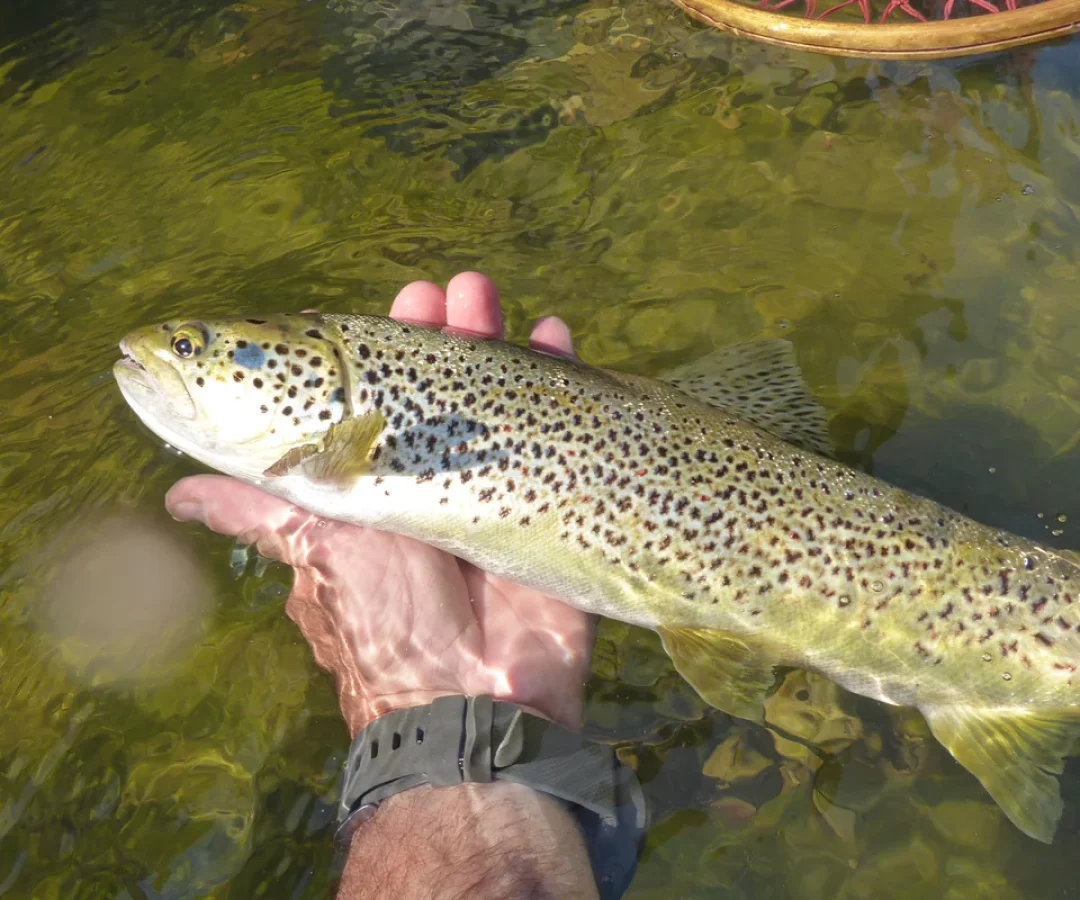
Brown trout (Salmo trutta) are the backbone of French fly fishing. Two distinct subspecies exist: the Atlantic brown trout across northern and western France, and the Mediterranean or zebra trout (Salmo trutta macrostigma) of the south and south-east. The zebra trout is a good-looking fish — red-spotted, vividly marked, and increasingly protected through no-kill regulations. Both strains are wild and self-sustaining in quality first-category rivers.
Grayling (Thymallus thymallus) turn up in select rivers, notably the Ain, sections of the Doubs, and parts of the upper Rhône drainage. Less common than in Austria or Slovenia, but where they occur the dry fly fishing is superb.
Brook trout (Salvelinus fontinalis) were introduced to high mountain lakes in the Alps and Pyrenees and have naturalised well. Often the only species in lakes above 2,000 metres. Good fun on light tackle.
Rainbow trout (Oncorhynchus mykiss) exist in France mostly through stocking on second-category waters. Not a focus for most travelling fly fishers but they turn up in first-category rivers near stocked lakes from time to time.
Atlantic salmon (Salmo salar) run the rivers of the Pyrenees (Gave d’Oloron system), Normandy, and Brittany. Populations have dropped from historical levels but remain viable, particularly in the south-west. Salmon fishing requires a specific licence endorsement and strict catch regulations apply.
Arctic char (Salvelinus alpinus) live in a handful of deep alpine lakes, particularly in Haute-Savoie and Savoie. Hard to target on fly, but a prized catch for those who manage it.
March: Season opens in most departments around the second or third Saturday. Low-elevation rivers in the Massif Central, Jura foothills, and Pyrenean valleys are fishable. Water is cold and nymphing dominates. Mountain rivers are typically too high.
April: Conditions improve on lowland and mid-elevation rivers. The Ardèche, lower Ain, and Basque foothills fish well. First decent hatches begin. Mountain rivers still in snowmelt.
May: One of the best months for lowland and mid-elevation water. Major Mayfly hatches on the Jura rivers. The Hemingway Rio Irati expedition opens. Alpine rivers start to drop but can still be marginal.
June: The month I’d pick if I could only fish France once. Alpine rivers come into prime condition. Big sedge and Mayfly hatches. Mountain lakes below 2,000 metres open up. Long days. Water temperatures approach that ideal 12°C mark on most rivers.
July: Good across all regions. High mountain lakes fully accessible. Evening dry fly fishing at its peak on lowland rivers. Water temperatures can push trout into deeper, shaded lies on south-facing rivers — fish early and late.
August: Similar to July but warmer. Some low-elevation rivers suffer from heat and low water. Alpine and mountain streams stay in good shape. High mountain lakes at their best.
September: My second-favourite month. The crowds thin out, temperatures drop, and trout feed hard ahead of autumn. Alpine rivers are in great nick. The Jura’s grayling fishing comes into its own. Some departments close their trout season mid-September, so check local dates.
October: Season closes on most first-category waters. Some second-category fishing continues. Grayling stay open on certain rivers.
France runs a thorough fishing licence system managed through 97 departmental fishing federations (Fédérations Départementales de Pêche et de Protection du Milieu Aquatique). Every angler over 16 needs a valid carte de pêche. You can buy one online at cartedepeche.fr.
Licence types and approximate costs:
- Daily licence (carte journalière): €15–18
- Weekly licence (carte hebdomadaire): €34–40
- Annual licence (carte personne majeure): €80–105
- Children/youth (carte découverte -12 ans): €7
Your licence is valid for the department where you buy it, plus any reciprocal departments. Three main reciprocity agreements exist — EHGO, CHI, and URNE — which together cover most of France, but not every department participates in all of them. If you plan to fish across multiple regions, check the reciprocity maps or just buy licences for each department. It’s not expensive.
First-category vs second-category waters: First-category waters are salmonid rivers (trout, salmon, grayling) with stricter season dates, typically mid-March to mid-September. Second-category waters hold coarse fish and have longer seasons. The distinction matters — fishing a first-category river outside season carries a fine of up to €450.
Special parcours (designated stretches):
- Parcours no-kill (sans tuer): Mandatory catch and release
- Parcours mouche: Fly only, often barbless hooks required
- Parcours découverte: Beginner-friendly stretches with relaxed regulations
- Parcours sportif: Special regulations promoting quality fishing
- Parcours touristique: Tourist-oriented stretches, sometimes stocked
Fishing without a licence is a €450 fine. Carry your carte de pêche at all times — river bailiffs (gardes-pêche) do check, especially on popular stretches. Our guides sort out licences for their clients as part of the booking.
Euro nymphing: France’s contribution to fly fishing
Modern competition nymphing was born on French rivers. French and Spanish anglers developed the tight-line, leader-to-the-fly techniques that now dominate world championship circuits. Fish the Chéran or the upper Ain and you’ll understand why: the fish are educated, the water is clear, and a conventional indicator rig might as well be a warning flag.
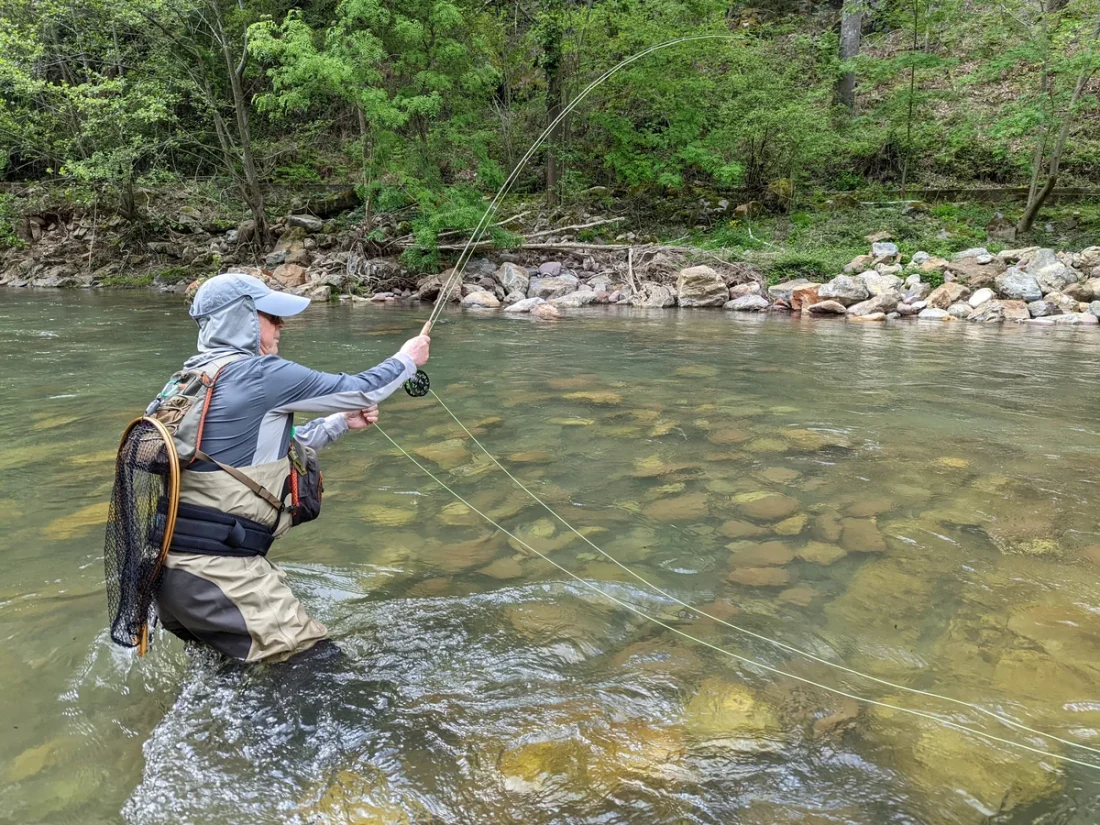
The French style uses long rods (10 to 11 feet in a 3-weight), ultra-thin leaders extending well past the rod tip, and direct contact with the fly through a coloured sighter section. Flies are typically slim, tungsten-beaded nymphs in sizes 14 to 20 — the Perdigon, GRHE (Gold-Ribbed Hare’s Ear), and Pheasant Tail in various weights are the standards. The technique demands precise casting, constant adjustment of depth and drift, and total focus on the sighter for the slightest hesitation that signals a take.
If you’ve never euro nymphed on the rivers where it was developed, a day with a French guide who competes at national level is a proper education.
CDC dry flies
Cul de canard — the oil-impregnated feathers from around a duck’s preen gland — was popularised as a fly tying material largely through the work of Swiss-born, French-influenced tier Marc Petitjean. CDC dry flies are everywhere now, but they’re still particularly effective on French rivers where trout have evolved alongside natural insects in clear, slow currents that allow close inspection of your fly.
French dry fly boxes lean heavily on CDC emergers, CDC shuttlecocks, and simple hackled patterns. The Parachute Adams, Deer Hair Sedge, and various CDC olive patterns cover most situations. Sizes 14 to 20 handle the majority of hatches, though the Jura sometimes demands smaller.
Tenkara & TLT
Tenkara (fixed-line fly fishing, no reel) has a dedicated following in France, particularly in the Pyrenees and on small mountain streams where a fly reel adds nothing but weight. Our Basque Country guide Yvon Zill is a certified Tenkara instructor and fishes it as his primary method.
TLT (Técnica Lanzado Total) is a Spanish-influenced technique popular in southern France that uses long, supple rods and weighted wet flies fished downstream. It’s effective on larger Pyrenean rivers where trout hold in fast, turbulent water.
Accommodation: France has no dedicated fly fishing lodges like New Zealand, Montana, or Patagonia. This is actually a good thing: you stay in gîtes ruraux (self-catering cottages), small hotels, chambres d’hôtes (B&Bs), or mountain refuges, all at a fraction of lodge prices. In the Hautes-Alpes, a comfortable gîte sleeping four costs €60–100 per night. A good hotel in a Basque village runs €80–120. The savings on accommodation leave more budget for guided days on the water.
Finding guides: France’s professional fishing guides are organised under the SMPGF (Syndicat des Moniteurs et des Professionnels de la Gestion de la Pêche en France), which represents over 2,000 certified guides across the country. All hold state-recognised diplomas and carry professional insurance. We’ve fished with our partner guides personally and can match you with the right person for your target species, region, and experience level.
Getting there: France is well served by international airports. For the Alps, fly into Lyon, Marseille, or Turin (Italy). For the Riviera rivers, Nice is ideal — Guillaume Durand’s water is less than an hour from the airport. For the Pyrenees, Toulouse or Biarritz. Paris connects to everywhere by TGV. You’ll need a hire car to reach the river valleys.
Non-fishing activities: This is where France pulls ahead of almost every other fly fishing destination. Your non-fishing travel companions can visit medieval castles, UNESCO World Heritage sites, and world-class museums while you’re on the river, and you’ll meet up again over a dinner that makes the whole trip worth it. The Basque Country has its own distinct cuisine, language, and culture. The Riviera needs no introduction. Even the quiet Hautes-Alpes has excellent local cheeses, wines from the southern Rhône, and the fortified old town of Briançon — the highest city in France.
Budget comparison: A self-guided week (car hire, gîte, daily licence, food) in the French Alps runs comfortably at €800–1,000 per person. Add two or three guided days at €150–300 each and your total trip cost wouldn’t cover two nights at a New Zealand fly fishing lodge.
Rods: A 9-foot 4-weight handles most French trout rivers. Bring a 10- or 10.5-foot 3-weight if you plan to euro nymph (and you should). A 9-foot 5- or 6-weight is useful for larger Pyrenean rivers, salmon water, or windy days on mountain lakes. If you’re fishing small streams with Tenkara, your guide will usually provide the rod.
Reels: Nothing fancy. A simple click-and-pawl or sealed-drag reel matched to your rod weight is fine. You won’t be fighting fish into the backing on French trout rivers.
Waders: Breathable chest waders with felt-soled or rubber-soled boots. Riverbeds in the Alps and Jura can be slippery. Some French departments have banned felt soles to prevent didymo spread — check local rules before you go. Wet wading works from July through August on lower-elevation rivers.
Leaders and tippet: Carry a range from 4X to 7X in both nylon and fluorocarbon. The Jura and pressured alpine rivers routinely demand 6X or 7X. Euro nymphing leaders are specialised — your guide can advise or provide one, but a 20-foot tapered leader with a coloured sighter section is standard.
Essential flies:
- Nymphs: GRHE sizes 14–18, Pheasant Tail Nymph sizes 14–20, Perdigon in black, olive, and copper sizes 14–18, small copper-beaded caddis pupae
- Dry flies: CDC emergers sizes 16–20, Parachute Adams sizes 14–18, Deer Hair Sedge sizes 12–16, CDC olive dun sizes 16–20, black ant and beetle terrestrials sizes 14–18
- Wet flies: Partridge and Orange sizes 14–16, French Tricolore, soft hackle spiders
Other essentials: Polarised sunglasses (critical on clear French rivers), a landing net with rubber mesh, forceps for hook removal, a lightweight rain shell (mountain weather turns fast), and sunscreen. The sun in the southern Alps and Riviera hits hard from June onward.
FREQUENTLY ASKED QUESTIONS
Yes. Every angler over 16 needs a valid carte de pêche (fishing licence), available online at cartedepeche.fr. Daily licences cost €15–18, weekly €34–40, annual €80–105. Fishing without one carries a €450 fine, and river bailiffs do check. If you book a guided trip through us, your guide will sort out the licence for you.
First-category trout waters generally open mid-March to mid-September, though exact dates vary by department. Mountain rivers in the Alps and Pyrenees are practically fishable from June to early October once snowmelt drops. Second-category waters have longer seasons. Your guide will confirm specific dates for your chosen region.
Yes. France has extensive public fishing access, and the licence system is straightforward once you get your head around it. But a local guide makes a big difference — they know which stretches are fishing well, where to get on the river, what’s hatching, and how to deal with the department-specific regulations. We recommend at least one or two guided days even on a self-guided trip.
Wild brown trout (both Atlantic and Mediterranean/zebra strains) are the main target on first-category rivers. Grayling are available on select rivers like the Ain and Doubs. Brook trout and Arctic char live in high mountain lakes. Atlantic salmon run the Gave d’Oloron system in the Pyrenees and rivers in Normandy and Brittany. Southern barbel are common in Basque and Provençal rivers and put up a surprisingly good fight on a fly rod.
The fish are generally smaller — a 40-centimetre wild brown is a good fish on most French rivers, and anything over 50 centimetres is one to remember. But the fishing is technically superb, the landscapes rival anywhere, the variety of water types within a small area is hard to match, and the cultural side (food, wine, history) makes France a complete holiday rather than just a fishing trip. It’s also a lot cheaper.
Euro nymphing is devastatingly effective and was essentially developed on French rivers — it’s the go-to on pressured water. CDC dry flies are standard for rising fish. Tenkara works well on small mountain streams. Wet fly and soft hackle techniques are still effective, particularly in the Pyrenees. Your guide will match the technique to conditions, and most are happy to teach methods you haven’t tried.
A self-guided week covering car hire, gîte accommodation, daily licences, and food comes in at €800–1,000 per person. Guided days range from €100 for a three-hour initiation to €310 for a full-day specialist expedition. Flights from the UK start around €50–100 return on budget carriers. From further afield, international flights into Lyon, Nice, Toulouse, or Paris give good access to all regions. France is significantly cheaper than Scandinavian, Icelandic, or Southern Hemisphere fly fishing destinations.