
FLY FISHING IN INDIA
Hunt the legendary golden mahseer in the wild Himalayan rivers of Northern India. Experience fly fishing at its most raw and powerful where every cast could connect you to the hardest-fighting freshwater fish on earth.
About the Destination
INDIA. THE LAST FRONTIER OF FLY FISHING
India is fly fishing’s best-kept secret — a destination that belongs on every serious angler’s bucket list. The Himalayan foothills of Uttarakhand, where the Saryu and Mahakali rivers converge at the ancient village of Pancheshwar, offer what many consider the most thrilling freshwater fishing experience on the planet: casting to golden mahseer in fast, powerful Himalayan currents.
What makes fly fishing in India truly extraordinary is the combination of raw wilderness, a fish of almost mythical status, and an angling tradition that stretches back to the days of the British Raj. Rudyard Kipling called the mahseer a fish “beside whom the tarpon is a herring” and anyone who has felt the explosive take of a golden mahseer on a fly rod will understand why. These are not gentle risers sipping mayflies. They are muscular, aggressive predators that use the full force of Himalayan rapids to test every inch of your tackle and nerve.

FEATURED FLY FISHING TRIPS
Guided fly fishing expeditions in the Himalayan rivers of Northern India
GOLDEN MAHSEER — SARYU RIVER
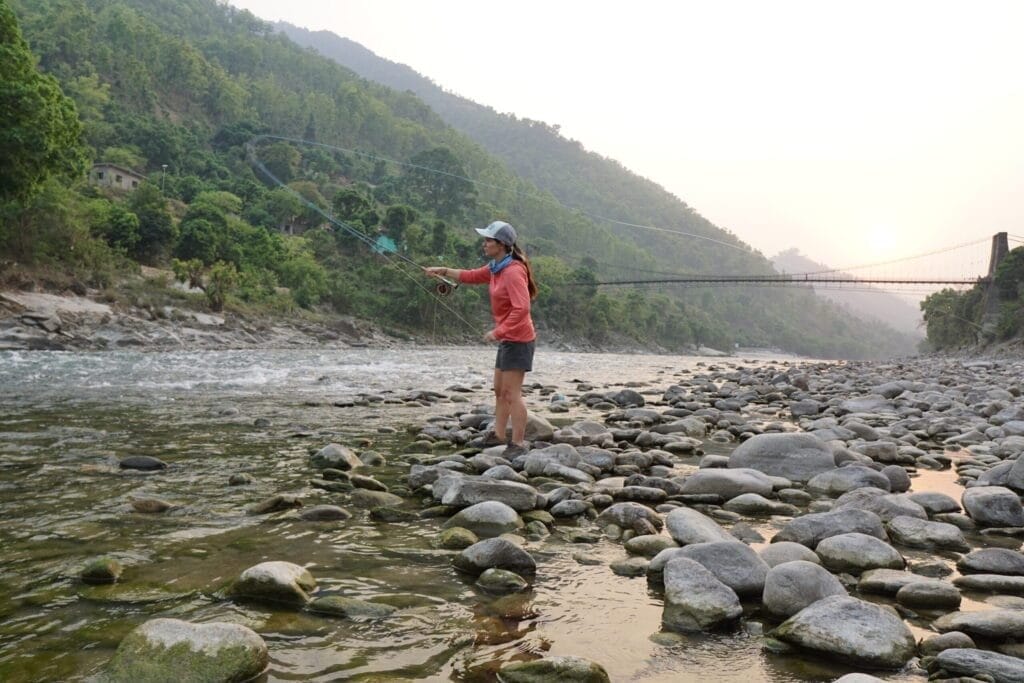
The ultimate golden mahseer fly fishing experience. Fish the legendary Saryu River at Pancheshwar — known as the mecca of mahseer fishing in North India — where the river meets the Mahakali at the India-Nepal border. Wade through powerful rapids and fish deep pools where golden mahseer averaging 10 to 15 pounds ambush prey in fast water. Fish of 20 pounds and above are caught every season, and the explosive takes in heavy current deliver a fight that is genuinely not for the faint-hearted. Your guide will position you on the best pools, advise on fly selection, and net fish that will test your 8-weight to its limit.
Duration: Minimum 3 Days
Price: Enquire for Rates
Species: Golden Mahseer
SARYU & MAHAKALI FLOAT TRIP
Combine fly fishing for golden mahseer with a rafting adventure through some of the most remote river gorges in the Indian Himalayas. Float the Saryu and Mahakali rivers, stopping to fish the best pools and runs as you travel through pristine jungle wilderness. This is expedition-style fishing at its finest — riverside camping under the stars, gourmet meals prepared by dedicated chefs, and access to water that sees almost no angling pressure. Along the way, you may spot otters, gharial crocodiles, and a stunning array of Himalayan birdlife. The float trip is the best way to cover the most productive water and experience the full majesty of these rivers.
Duration: Minimum 4 Days
Price: Enquire for Rates
Species: Golden Mahseer, Goonch Catfish

Why Fly Fish India
WHAT MAKES INDIA FLY FISHING DIFFERENT
THE ULTIMATE FRESHWATER FIGHTER
The golden mahseer is pound-for-pound one of the hardest-fighting freshwater fish on earth. Hooked in fast Himalayan current, even a 15-pound fish will test your tackle, your drag, and your nerve. Kipling called it the mightiest fish that swims — and he was not exaggerating.
PRISTINE HIMALAYAN WILDERNESS
Fish rivers that carve through untouched jungle gorges at the foothills of the Himalayas. The Saryu and Mahakali rivers at Pancheshwar flow through landscapes so wild and remote they feel like stepping back centuries. This is genuine frontier fishing in one of the world’s last unspoilt places.
20+ YEARS OF EXPERTISE
Our partner, outfitters, have operated specialist mahseer expeditions since 2004. Their guides know every pool, rapid, and holding lie on these rivers. Safari-style camps with dedicated chefs and full equipment mean you fish in comfort even in the most remote locations.
Practical Info
SEASON & BEST TIME TO VISIT
Season: The prime months for golden mahseer fishing in India are April, May, June, and October. The pre-monsoon period (April–June) offers warming water temperatures that trigger aggressive feeding, with mahseer moving into the faster runs and pools. October, immediately after the monsoon, brings high water levels, powerful fish in peak condition, and some of the largest specimens of the year. The monsoon months (July–September) make the rivers unfishable, and the cooler winter months (November–February) see reduced mahseer activity.
Getting There: Fly into New Delhi, then take a domestic flight to Pantnagar (the nearest airport to Pancheshwar). From Pantnagar, it is approximately a 6-hour scenic drive through the Kumaon Hills to the riverside camp. The Himalayan Outback arranges all transfers from Pantnagar. Alternatively, the drive from Delhi takes around 10–12 hours via Haldwani.
What’s Included
YOUR TRIP PACKAGE
- Expert local guides with 20+ years of mahseer fishing experience
- All fishing permits and access arrangements
- Quality fly and lure fishing equipment provided
- Safari-style riverside camp with dedicated chef
- All meals, refreshments, and camp accommodation
- Transfers from Pantnagar airport to camp and return
What Our Anglers Say
Trusted by anglers worldwide to deliver unforgettable golden mahseer fly fishing experiences in the Indian Himalayas.
“Pancheshwar exceeded every expectation. On day two, I hooked a golden mahseer that took me 200 metres downstream through three rapids before we finally netted it — 22 pounds of pure gold. The guides, the camp, the food — everything was world-class. This is genuinely the fishing trip of a lifetime.”
David H. United Kingdom
“I’ve fished for tarpon, permit, and GT — and the golden mahseer fights harder than all of them. The setting is unbelievable: jungle gorges, clear Himalayan water, and not another angler in sight. Misty and the Himalayan Outback team made everything seamless from start to finish. Already planning my return trip.”
Chris and Laura M. United States
READY TO FLY FISH INDIA?
Tell us what you’re after — a dedicated golden mahseer expedition, a Saryu & Mahakali float trip, or a combination with wildlife safaris and Himalayan trekking — and we’ll build an India fly fishing holiday around your goals. No commitment, no pressure — just honest advice from people who’ve fished these rivers.
ENQUIRE NOW
READ MORE ABOUT FLY FISHING IN INDIA
Fly fishing in India for golden mahseer is unlike any other freshwater fishing experience on earth. The golden mahseer (Tor putitora) is a large, powerful cyprinid native to the fast-flowing rivers of the Himalayas. Fish averaging 10 to 15 pounds are common, 20-pound specimens are caught every season, and the Indian record stands at well over 50 pounds. Rudyard Kipling famously described the mahseer as a fish “beside whom the tarpon is a herring and he who catches him can say he is a fisherman.”
The fishing is conducted primarily by wading — casting into deep pools, fast runs, and the turbulent water below rapids where mahseer hold and ambush prey. Both fly fishing and lure fishing are productive. On the fly, large streamers, woolly buggers, and Clouser-style patterns fished on sinking lines work best, though surface takes on deer-hair patterns during the right conditions provide the most explosive action. The fight of a hooked mahseer in fast Himalayan current is genuinely extraordinary — these fish use every feature of the river to their advantage, running downstream through rapids and holding in heavy water where even experienced anglers struggle to turn them.
All fishing is strictly catch and release. The golden mahseer is classified as endangered by the IUCN, and conservation is a core principle of every expedition. Barbless hooks, proper handling techniques, and minimal air exposure ensure every fish is returned safely.
The primary fishing destination is Pancheshwar, a remote village in Uttarakhand where the Saryu River meets the Mahakali River at the India-Nepal border. This confluence has been recognised as the mecca of mahseer fishing in North India for over a century, drawing anglers from the days of Jim Corbett and the British Raj to the present day.
The Saryu River flows through deep jungle gorges, offering a mix of fast rapids, deep pools, and long glides that hold golden mahseer throughout the season. The river is accessible by wading from the riverside camp at Pancheshwar, with the best pools within walking distance. The Saryu also holds silver mahseer and several other native species.
The Mahakali River forms the border between India and Nepal and is a significantly larger, more powerful river. The float trip down the Mahakali combines rafting with fishing, accessing remote pools that see virtually no angling pressure. This river also holds the giant goonch catfish — a prehistoric-looking species that can exceed 100 pounds and provides extraordinary sport on heavy tackle.
The landscape is stunning: forested Himalayan foothills rising steeply from the riverbanks, with snow-capped peaks visible in the distance. Wildlife is abundant — otters, gharial crocodiles, langur monkeys, and over 300 species of birds inhabit the river corridors.
Most international visitors fly into New Delhi (Indira Gandhi International Airport). From Delhi, there are two main routes to Pancheshwar:
Option 1 — Fly + Drive: Take a domestic flight from Delhi to Pantnagar Airport (approximately 1 hour). From Pantnagar, it is a 6-hour drive through the scenic Kumaon Hills to Pancheshwar. This is the recommended route and all airport transfers are arranged by The Himalayan Outback.
Option 2 — Drive from Delhi: The road journey from Delhi to Pancheshwar takes approximately 10–12 hours via Haldwani and Champawat. This is a long but scenic drive through the Himalayan foothills, and can be broken with an overnight stop en route.
The Himalayan Outback arranges all logistics from your arrival point — airport pickup, road transfers, and delivery to the riverside camp. India requires a tourist visa for most nationalities, which can be obtained as an e-Visa online before departure. Your passport must be valid for at least 6 months beyond your travel dates.
For fly fishing for golden mahseer, an 8 or 9-weight rod is the standard setup. A 9-foot 8-weight covers most situations; a 9-weight provides extra backbone for larger fish in heavy current. Bring a quality reel with a strong, smooth drag and at least 150 metres of backing — hooked mahseer will test your drag system like few other freshwater fish.
Sinking lines (intermediate and fast-sink tips) are essential for fishing the deep pools and fast runs where mahseer hold. A floating line is useful for surface work when conditions allow. Leaders of 15–20lb fluorocarbon are standard. Flies should include large woolly buggers (size 2–6), Clouser minnows, heavy nymphs, and deer-hair surface patterns.
All fishing equipment is provided by The Himalayan Outback if you prefer not to bring your own. Their guides carry quality fly and lure tackle suited to the conditions.
What to pack: Lightweight, quick-dry clothing in neutral colours. Sturdy wading boots with good ankle support (felt or rubber soles). A wading jacket for spray in the rapids. Sun protection (hat, polarised sunglasses, high-SPF sunscreen). Insect repellent. A headlamp for camp. Temperatures range from 15–35°C depending on season, so layers are advisable.
India offers extraordinary experiences beyond the river for non-fishing partners or rest days. The Himalayan Outback also operates wildlife safaris to Jim Corbett Tiger Reserve (one of India’s premier national parks for Bengal tiger sightings), Himalayan trekking through alpine meadows and remote villages, and birdwatching tours in some of the most biodiverse habitats in Asia.
The Kumaon Hills region around Pancheshwar is culturally rich — ancient temples, traditional hill villages, and a slower pace of life that feels worlds away from the bustle of Indian cities. The Himalayan Outback also runs a boutique lodge on the Ramganga River near Jim Corbett, offering a luxurious base for combining a fishing expedition with a wildlife safari.
For those wanting to extend their trip, India’s diversity is unmatched: from the deserts of Rajasthan to the backwaters of Kerala, the Himalayan peaks of Ladakh to the beaches of Goa. A golden mahseer expedition can be the centrepiece of a wider Indian adventure.
FREQUENTLY ASKED QUESTIONS
All levels are welcome. The Himalayan Outback’s guides tailor each day to your ability — from teaching casting fundamentals on easier water to positioning experienced anglers on the most technical and productive pools. Lure fishing is also available and can be equally productive for mahseer, so non-fly-anglers are well catered for. The physical element (wading in strong current over rocky terrain) does require a reasonable level of fitness.
The prime months are April, May, June, and October. The pre-monsoon period (April–June) sees warming water and increasingly active fish, with May and June often producing the most consistent sport. October, immediately after the monsoon, brings high water, powerful fish in peak condition, and some of the largest mahseer of the year. The monsoon (July–September) makes the rivers unfishable. Winter months (November–February) see reduced activity as water temperatures drop.
No — The Himalayan Outback provides all fly and lure fishing equipment as part of the trip package. If you prefer to bring your own gear, an 8 or 9-weight fly rod with sinking lines and 15–20lb leaders is the standard setup. All equipment should be cleaned and dried before arrival.
Yes — 100% catch and release on all trips. The golden mahseer is classified as endangered by the IUCN, and conservation is a core principle. Barbless or de-barbed hooks, proper fish handling, and minimal air exposure are mandatory. This commitment to conservation is one of the reasons the fishing at Pancheshwar remains exceptional after decades of operation.
Trip pricing varies depending on duration, group size, and whether you choose a river-based camp expedition or a float trip. Contact us with your preferred dates and group size and we’ll provide a detailed quote. All trips include guiding, equipment, accommodation, meals, and transfers from Pantnagar airport.
Absolutely — The Himalayan Outback also operates wildlife safaris (including Jim Corbett Tiger Reserve), Himalayan trekking expeditions, and birdwatching tours. Multi-activity itineraries are a popular option, especially for travelling with a non-fishing partner. We can build a combined trip that includes golden mahseer fishing alongside tiger safaris, mountain treks, or cultural experiences in the Kumaon Hills.
Most nationalities require a tourist visa to enter India. The simplest option is an e-Visa, which can be applied for online before departure. Processing typically takes 3–5 business days. Your passport must be valid for at least 6 months beyond your travel dates. We recommend applying at least 4 weeks before your trip.